Like with any skill, repeated practice and exposure is the key to your students truly understanding and mastering the skill. As I'm planning for the week ahead, I'm racking my brain and resources for character traits ideas and activities. After coming up a wee bit short, I turned to Pinterest and the world wide web. What follows is simply a collection of resources, ideas, and activities I have found and plan on tweaking to meet the needs of my kiddos. I do NOT take credit for any of these great ideas, simply passing along some great resources in one location.
Starting with a Mentor Text

At Lesson Plan SOS there is a great activity use the story Bad Case of the Stripes. Her blog not only contains info on this great idea, but also several other mini-lessons and activities using the same book. Here is a link to her Camilla Character Trait FREEBIE!!
Providing Hand-outs & Resources for Students
Although you don't want students to become dependent on a list of traits, it is definitely a great thing to use in the beginning and to serve as a reference throughout the application of the skill. It's also a great writing resource to help them expand their vocabulary.
 Here is one such Character Trait list. It's from the blog Workshop Classroom, and I especially love this one because it breaks the traits up into categories and categorizes them. I think that this would be great for ELL students and those who need a little extra support. Here's a direct link to the FREEBIE.
Here is another list. This one is from Totally Terrific in Texas' blog. She includes the list and a character map via a google doc. (Also a FREEBIE!)
Interactive Notebook Fold-able for Hands-on Practice

One your kiddos have learned how to use a character's words, thoughts, and actions to infer a character trait, it's time for them to practice. We are currently reading the novel Out of My Mind by Sharon Draper, so I am going to have my kids analyze the characters in the chapters we are reading. Instead of just giving them a worksheet, I'm going to have them do a fold-able to put in their interactive reading notebook. Here is an example of one possible foldable to use by Teaching in Wonderland. (Bonus: It's a FREEBIE!)
Fun "Skill to Self" Connection Activity
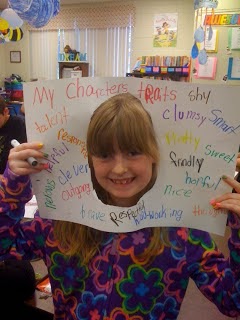
Over at Adventures of Room 129's blog, there's a super cute idea for kids to create a frame that gives them the chance to display some of their own character traits. I' m thinking that after kids create their frame, I'll give them a chance to pick one trait that describes them to share with a partner and then give 'evidence' from their life to prove that it's an accurate trait to describe themselves. For further connection and rigor, kids can then think of a character from a story they have read that shares the same character trait.
Do you have any other great ideas? I'd love to hear them and "borrow" them for my classroom :) Feel free to put them in the comments below.


